GT Haptik is a monolinear geometric Grotesk typeface. Its uppercase letters and numbers were optimized to be read blindfolded and by touching them. The family is made up of seven weights with accompanying Oblique, Rerotalic, and Rotalic styles. Included with each style come alternate characters — the boring ones.
- GT HaptikDesigned by Reto Moser, Tobias Rechsteiner. Released in 2010/2014
- Available in 21 stylesSeven weights Upright, Oblique and Rotalic
- Latin Extended187 supported languages
- Visit GT Haptik Minisite
Design
Form follows touch
The uppercase letters and numerals were stripped of standard optical corrections, adjustments like rebalancing stroke weights or repositioning crossbars that the eye expects but the fingertip doesn’t need. Certain letterforms like the R, C, and G carry specific contour features designed to guide the finger along their shape. The lowercase, added later for text use, follows more conventional optical principles, since tactile legibility at that scale was never the goal. Every visual quirk is a direct consequence of function.
Aa
Aa
Aa
Specimen
GRASP
V. van Gogh Self-Portrait w. Straw Hat Summer 87 Amsterdam

The origins of this movement can be traced back to pioneers like Vincent van Gogh, Edvard Munch, and James Ensor, who used vibrant colors and raw techniques to express personal angst. By 1905, German artists formed influential groups…
In the autumn of 1888, the sleepy southern French town of Arles became the stage for one of the most intense, brilliant, and ultimately disastrous partnerships in art history. Vincent van Gogh, yearning to escape the dreary Parisian winters and establish an “Art of the South” collective, rented a modest building with a vibrant yellow facade. He called it the Yellow House. To Vincent, this was not just a home, but the seed of a utopian brotherhood of painters. He begged Paul Gauguin to join him, coaxing his friend with promises of shared expenses, brilliant sunlight, and the financial backing of his art-dealer brother, Theo van Gogh. Gauguin, perpetually broke and seeking a fresh start, finally arrived in late October. At first, the collaboration was a whirlwind of frantic creativity. The pair worked side by side, painting the local countryside, portraits of townspeople, and quiet indoor scenes, constantly debating…
Youth (1907) The Swan (1915)
At first, the experiment felt like a triumph. The two men threw themselves into their work, setting up their easels side-by-side in the cramped studio of the Yellow House. They painted the same landscapes, the same local models, and even each other. It was a period of astonishing productivity; the sheer creative friction between them pushed both artists to paint with an urgency they had never before experienced. Yet, beneath the initial excitement, deep philosophical and personal fault lines began to run through their relationship. The primary friction lay in their approach to creation. Van Gogh was a painter of raw, emotional…
He loaded his canvas with thick impasto, using intense, vibrant colors to express his innermost feelings. Gauguin, by contrast, was a symbolist who advocated painting from memory and imagination. He urged Vincent to simplify, to construct flat shapes, and to look inward rather than copy nature. “Art is an abstraction,” Gauguin insisted, while Van Gogh maintained that truth lay in the physical world before him. These artistic debates quickly spilled over into their daily life. They lived in close quarters on a razor-thin budget, and their highly contrasting personalities began to clash. Gauguin was orderly, dominant, and deeply cynical; Van Gogh was volatile…
Gauguin complained that Vincent’s hygiene was lacking and that he mismanaged their household funds. Van Gogh, sensing his friend’s growing desire to pack his bags and return to Paris, fell into a state of deep anxiety and paranoia. The local cafés and brothels they frequented became battlegrounds for their increasingly heated, absinthe-fueled arguments. By December, the atmosphere inside the Yellow House had grown suffocatingly tense. On the evening of December 23, 1888, the pressure finally shattered the partnership. Following a fierce altercation, Gauguin fled the house to sleep at a local hotel. In a state of severe mental crisis and desperate…
H. Klint
To her, evolution represented the multi-dimensional ascension of the human soul. It tracked the soul’s journey from a heavy, fragmented physical existence back to a state
Angle
Angle
Angle
Angle
Angle
Angle
Angle
Rotate
Rotate
Rotate
Rotate
Rotate
Rotate
Rotate
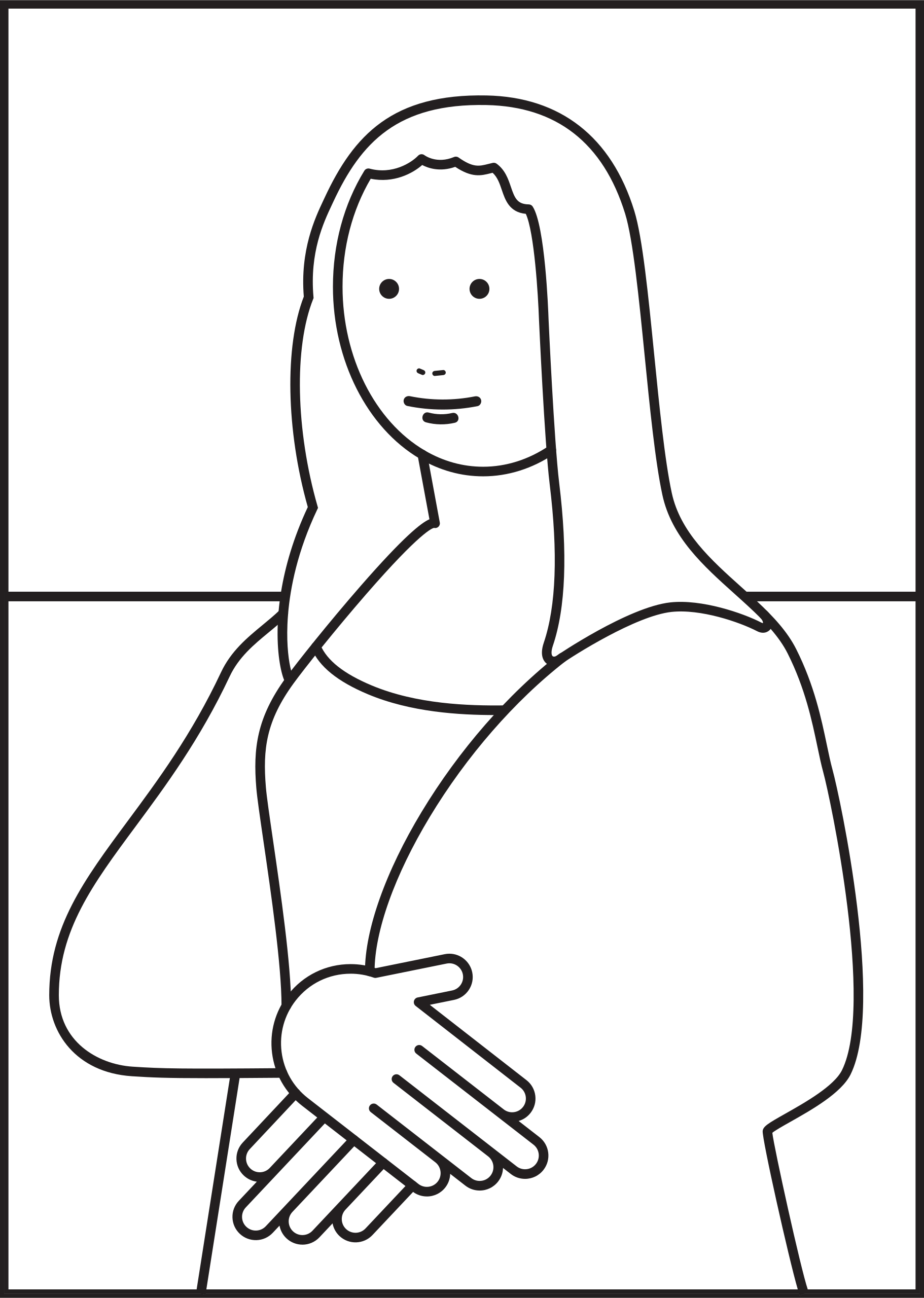
The death of her younger sister, Hermina, in 1880 drew af Klint deeply into spiritualism. In 1896, she and four other women formed a secret group called De Fem (The Five). They met weekly for seances, practicing meditation and “automatic writing” — allowing spiritual entities to guide their pencils across paper decades before the Surrealists claimed the technique. During one of these sessions in 1904, a spiritual entity named Ananda commissioned af Klint to create a massive body of work. This celestial task was to visualize the invisible, spiritual dimension of the universe. Accepting this “great…
Between 1906 and 1915, af Klint created her magnum opus: Paintings for the Temple. This staggering cycle of 193 predominantly abstract canvases sought to map the cosmos and represent the unity of all life. Within this cycle was The Ten Largest, a series of monumental, ten-foot-tall tempera paintings depicting the stages of human life. Breaking away from traditional academic techniques, these works featured biomorphic shapes, spirals, sweeping loops, and vibrant pastel hues that pulsed with natural energy. Af Klint’s visual language combined scientific concepts — like x-rays…
Though she believed her work was meant for a physical, spiral-shaped temple, she soon realized the world was not ready for her radical art. Even the prominent spiritual leader Rudolf Steiner, whom she deeply respected, was baffled by her mediumistic approach when he viewed them. Convinced that future generations would possess a deeper understanding, af Klint stipulated in her will that her abstract paintings — over 1,000 works and 125 notebooks — must remain sealed and hidden from the public for at least twenty years after her death. When af Klint died in 1944 following a tram accident, her extraordinary…
Specs
Everything else you need to know
Standard Collection
Latin
Rerotalic Collection
Latin
Rotalic Collection
Latin
Uppercase Basic
Lowercase Basic
Uppercase Extended
Lowercase Extended
Alternate Letters
Numerals
Symbols & Punctuation
Arrows
CHAGALL
Rembrandt
Year 2000
0123456789
Credits
Designed by Reto Moser, Tobias Rechsteiner.
Released in 2010/2014.
Minisite

Specimen

OpenType Features
aalt, case, ccmp, cpsp, dnom, frac, kern, liga, mark, mkmk, numr, ordn, pnum, rlig, salt, sinf, ss01, ss02, ss03, ss04, subs, sups, tnum, zero
ss02 Stylistic alternates C, G
ss03 Stylistic alternate R
ss04 Alternate zero
Language Support
Latin Extended
Afaan, Afar, Afrikaans, Albanian, Alsatian, Amis, Anuta, Aragonese, Aranese, Aromanian, Arrernte, Asturian, Atayal, Aymara, Azerbaijani, Basque, Belarusian, Bemba, Bikol, Bislama, Bosnian, Breton, Cape Verdean Creole, Catalan, Cebuano, Chamorro, Chavacano, Chichewa, Chickasaw, Cimbrian, Cofán, Cornish, Corsican, Creek, Croatian, Czech, Danish, Dawan, Dholuo, Drehu, Dutch, English, Estonian, Faroese, Fijian, Filipino, Finnish, French, Frisian, Friulian, Galician, Ganda, Genoese, German, Gikuyu, Gooniyandi, Greenlandic (Kalaallisut), Guadeloupean Creole, Gwich’in, Haitian Creole …
Design Space
Standard Collection
14 styles- Lazer
- 1 / 0°
- Lazer Oblique
- 1 / 7°
- Thin
- 100 / 0°
- Thin Oblique
- 100 / 7°
- Light
- 300 / 0°
- Light Oblique
- 300 / 7°
- Regular
- 400 / 0°
- Regular Oblique
- 400 / 7°
- Medium
- 500 / 0°
- Medium Oblique
- 500 / 7°
- Bold
- 700 / 0°
- Bold Oblique
- 700 / 7°
- Black
- 900 / 0°
- Black Oblique
- 900 / 7°
Rerotalic Collection
7 styles- Lazer
- 1
- Thin
- 100
- Light
- 300
- Regular
- 400
- Medium
- 500
- Bold
- 700
- Black
- 900
Rotalic Collection
7 styles- Lazer
- 1
- Thin
- 100
- Light
- 300
- Regular
- 400
- Medium
- 500
- Bold
- 700
- Black
- 900