GT Canon

Family overview
- Condensed
- S Light Italic
- M Light Italic
- L Light Italic
- S Regular Italic
- M Regular Italic
- L Regular Italic
- S Medium Italic
- M Medium Italic
- L Medium Italic
- S Semibold Italic
- M Semibold Italic
- L Semibold Italic
- S Bold Italic
- M Bold Italic
- L Bold Italic
- S Heavy Italic
- M Heavy Italic
- L Heavy Italic
- S Black Italic
- M Black Italic
- L Black Italic
- Narrow
- S Light Italic
- M Light Italic
- L Light Italic
- S Regular Italic
- M Regular Italic
- L Regular Italic
- S Medium Italic
- M Medium Italic
- L Medium Italic
- S Semibold Italic
- M Semibold Italic
- L Semibold Italic
- S Bold Italic
- M Bold Italic
- L Bold Italic
- S Heavy Italic
- M Heavy Italic
- L Heavy Italic
- S Black Italic
- M Black Italic
- L Black Italic
- Standard
- S Light Italic
- M Light Italic
- L Light Italic
- S Regular Italic
- M Regular Italic
- L Regular Italic
- S Medium Italic
- M Medium Italic
- L Medium Italic
- S Semibold Italic
- M Semibold Italic
- L Semibold Italic
- S Bold Italic
- M Bold Italic
- L Bold Italic
- S Heavy Italic
- M Heavy Italic
- L Heavy Italic
- S Black Italic
- M Black Italic
- L Black Italic
- Extended
- S Light Italic
- M Light Italic
- L Light Italic
- S Regular Italic
- M Regular Italic
- L Regular Italic
- S Medium Italic
- M Medium Italic
- L Medium Italic
- S Semibold Italic
- M Semibold Italic
- L Semibold Italic
- S Bold Italic
- M Bold Italic
- L Bold Italic
- S Heavy Italic
- M Heavy Italic
- L Heavy Italic
- S Black Italic
- M Black Italic
- L Black Italic
- Expanded
- Mono
- Light Italic
- Regular Italic
- Medium Italic
- Semibold Italic
- Bold Italic
- Heavy Italic
- Black Italic
Subfamilies
- Standard S LightOnly that is limited can invite, can expand and intrude, or be intruded upon. No boundaries, nothing to transcend? At least nowhere to stay. Wandering does not leave any traces as long as it keeps up with the wandering of time.
- Standard M LightBalance is not symmetry. It is the tension between collapse and coherence. Therefore, it is the opposite of stillness. To speak of balance is to invoke the condition of something being held and not to be fixed. No conclusion but an ongoing relation.
- Standard L LightInstances correspond emphatically to design. Although the use of the term *instance *has become increasingly common in recent years, with specific uses in various disciplines, the underlying logic seems to have permeated the concept of design in an almost intrinsic way long before that.
- Standard S Light ItalicWhether we view design as ‘creating with existing means’ or not, upon closer inspection, design has always been about constantly arranging things, and not just since the advent of computers. The ongoing alignment of shapes, images, letters with one another and within their surface.
- Standard M Light ItalicOn the other hand, tools and designs are tailored to the user to such an extent that they do not even need to be used, as every possible action is anticipated, thus becoming literally useless, and the user, around whom everything revolved, has been relieved of their usage. Free, weight-, timeless and a fence observer. Rather than being oppressed by tradition and forced to master the tool as it has been forged over hundreds of years of craft.
- Standard L Light ItalicIn the war of Troy, the Greeks having sacked some of the neighbouring towns, and taken from thence two beautiful captives, Chryseïs and Briseïs, allotted the first to Agamemnon, and the last to Achilles.
- Standard S RegularTo lose face or to save face reveals the fragile, performative nature of this appearance. Therefore, naming a typeface is akin to attributing a paradoxical presence to letters, giving them an identity that is both personal and collective.
- Standard M RegularSince design means composing contrasts, creating tension can be a consequence. It’s not inevitable though. Contrast is no guarantee that tension will emerge. Quite the opposite. Tension is a rare commodity. Too much,and it dissipates. Often, the sweet spot lies in drawing the bow just far enough that it does not break.
- Standard L RegularContrast is difference made visible, the consequence and prerequisite of an appearance. Without contrast, there is no difference. Everything is not just monotonous, it simply is not. It is one and therefore isn’t. Contrast is the distance and proximity of the in-between. What is, is through difference.
- Standard S Regular ItalicBalance is not symmetry. It is the tension between collapse and coherence. Therefore, it is the opposite of stillness. To speak of balance is to invoke the condition of something being held and not to be fixed. No conclusion but an ongoing relation.
- Standard M Regular ItalicEdges mark the threshold of meaning, the moment when sense meets its outside of the inside of the outside of the sentence. And therefore all is exterior.
- Standard L Regular ItalicSo let us think of designers as those who constantly operate on the edge—whether with and on forms of recognition, or by allowing in the different, which fills the constantly repeating cascade of differences (from sensuality to imagination, from imagination to memory, from memory to forgetting, and finally to creative power (and then the whole thing starts all over again)).
- Standard S MediumNo doubt the feat was easy to Mr. Utterson; for he was undemonstrative at the best, and even his friendship seemed to be founded in a similar catholicity of good-nature. It is the mark of a modest man to accept his friendly circle ready-made from the hands of opportunity; and that was the lawyer’s way.
- Standard M MediumBalance is not symmetry. It is the tension between collapse and coherence. Therefore, it is the opposite of stillness. To speak of balance is to invoke the condition of something being held and not to be fixed. No conclusion but an ongoing relation.
- Standard L MediumAnd it is only the sequence of several nodes that determines the appearance. But especially in the visual realm, they lead a dubious existence. On the one hand, they are image-forming in vector image production, making it possible to create contours and surfaces in the first place; on the other hand, they ultimately recede behind the given image.
- Standard S Medium ItalicIt emerges through attention and waiver. Balance is not the absence of friction, but its distribution. Balance follows form, forms form, follows content, content which is shaping form, form flowing into form, unintentionally intentional.
- Standard M Medium ItalicA weight here presupposes a counter there, even if that counter is nothing but the absence of its here with reversed signs. Balance does not eliminate difference; it activates it, arranges it, gives it place.
- Standard L Medium ItalicQuoting is a technique of remembering. When we quote, we conjure up the past. We bring a text or an image from another time and place into a new environment. Remembering is a transformative process: what we remember is altered by adding, omitting or rewriting. The house is now red.
- Standard S SemiboldIt is one of the oldest branches of biological science, with its origins lying in early human attempts to understand the body by cutting it open, drawing it and naming its parts.
- Standard M SemiboldBroadly speaking, anatomy refers to the internal architecture of organisms, i.e. how bones, muscles, vessels, nerves and organs are arranged and how they relate to each other to form a functional whole.
- Standard L SemiboldEvery face is different, and every face is the same: it reveals not only itself, but the generality of its essence. Hence, every face is both singular and plural: this face, and the category of face. To call something a face is to give it agency, to acknowledge that it meets us.
- Standard S Semibold ItalicTension as a whole does not arise from the unrestrained or untamed wildness of individual elements. On the contrary, it is the right balance of unity and discipline on the one hand, and deviation on the other. In political and social contexts, the dissolution of tension is a noble and worthy pursuit. In design, it all too often leads to illegibility. This applies in both directions. After all, what is attraction, what is eroticism? The casual display of the fully revealed whole, or the play of gradually unveiling its parts? No tension, no relation.
- Standard M Semibold ItalicAnd yet, justification can mean a speech act of rare agency, inhabited with a groundless sorrow over the circumstances that necessitate it. Things should have been the other way around. From the start.
- Standard L Semibold ItalicEvery face is different, and every face is the same: it reveals not only itself, but the generality of its essence. Hence, every face is both singular and plural: this face, and the category of face. To call something a face is to give it agency, to acknowledge that it meets us.
- Standard S BoldBoth arise in a mutual interplay. Although drawing has never been just a medium of representation, but always also one of operation, one that forces the model into a certain order (line, proportion, grid, materiality), the introduction of nodes has given this reciprocal relationship a significant influence on authorship, insofar as it shifts slightly ‘in favour’ of the model: digital drawing can no longer not be a model, and from now on, the designer can no longer purely be a drawer but is always also a model-builder. Nodes allow form to be computed.
- Standard M BoldMoving a vector between applications can result in measurable shifts caused by floating-point limitations and incompatible Bézier implementations. In typography, the discrepancy is heightened: glyph outlines include instructions (hinting) that govern their behaviour at specific sizes, which are lost when text is converted to outlines. Thus, even in fields predicated on precision, scale introduces qualitative change not as an exception but as a structural condition.
- Standard L BoldThe reason, therefore, that some intuitive minds are not mathematical is that they cannot at all turn their attention to the principles of mathematics. But the reason that mathematicians are not intuitive is that they do not see what is before them, and that, accustomed to the exact and plain principles of mathematics, and not reasoning till they have well inspected and arranged their principles, they are lost in matters of intuition where the principles do not allow of such arrangement.
- Standard S Bold ItalicHe looked out the window at the Hudson River, ruddied in the flame of the dying sun, and wondered moodily whether these last experiments would finally bring him the fame and success he was after, or if they were merely some more false alarms.
- Standard M Bold ItalicWith this comes an epistemic shift: Drawing and model are interrelated, like hands touching each other. Each hand both touches and is touched, with their roles constantly shifting. And so drawing is not merely a representation of the model, and the model is not merely the origin of the drawing.
- Standard L Bold ItalicInstances correspond emphatically to design. Although the use of the term *instance *has become increasingly common in recent years, with specific uses in various disciplines, the underlying logic seems to have permeated the concept of design in an almost intrinsic way long before that.
- Standard S HeavyBroadly speaking, anatomy refers to the internal architecture of organisms, i.e. how bones, muscles, vessels, nerves and organs are arranged and how they relate to each other to form a functional whole.
- Standard M HeavyCompositional spaces or their amplifiers, such as grids, can also be seen as registers of response. To the questions the design willingly or unwillingly might need to respond to. And in this respect, too, the artboard extends far beyond the immediate surface into the problem definition, the historical and social context, the budget and time constraints, taste, and all other design premises or sudden contingencies.
- Standard L HeavyMoving a vector between applications can result in measurable shifts caused by floating-point limitations and incompatible Bézier implementations. In typography, the discrepancy is heightened: glyph outlines include instructions (hinting) that govern their behaviour at specific sizes, which are lost when text is converted to outlines. Thus, even in fields predicated on precision, scale introduces qualitative change not as an exception but as a structural condition.
- Standard S Heavy ItalicConsidering that the little party had been seated round the tea-table for less than twenty minutes, the animation observable on their faces, and the amount of sound they were producing collectively, were very creditable to the hostess.
- Standard M Heavy ItalicDepends on a ruler who can be deceived, attacked, and overthrown. Higher power unfolds beyond that. Smart, gentle, even “positive” power operates through consent, self-optimisation, and internalisation, not through prohibition or force.
- Standard L Heavy ItalicLetterforms were constructed, architectural drawings relied on projection, mechanical parts were dimensioned with astonishing precision. But as these constructions were “analogue”, they remained continuous. Enter the node: Forms are now discrete, shapes are a list of coordinates and continuity is produced by computational smoothing.
- Standard S BlackScaling therefore entails rounding operations and antialiasing strategies that alter the appearance of shapes, particularly at small sizes where a single pixel represents a significant portion of form. Software environments introduce further divergence, using distinct coordinate systems, unit definitions, and conversion routines.
- Standard M BlackWe meet in blurriness. If we understood each other completely, we would be identical and weightless, dissolving into pure oneness. Until that happens, however, recognising our differences and contrasts helps us to come closer together.
- Standard L BlackThis circumstance informs all aspects of the typeface design, from the architecture of the letters and the design of individual forms and components, to optical corrections (overshoot). Gravity manifests in stroke and proportion. The thickening of verticals, the grounding of serifs, the way curves rest against the baseline—all contribute to how a letter *sits *or stands..
- Standard S Black ItalicWandering does not leave any traces as long as it keeps up with the wandering of time. Edges mark the threshold of meaning, the moment when sense meets its outside of the inside of the outside of the sentence. And therefore all is exterior.
- Standard M Black ItalicThis circumstance informs all aspects of the typeface design, from the architecture of the letters and the design of individual forms and components, to optical corrections (overshoot). Gravity manifests in stroke and proportion. The thickening of verticals, the grounding of serifs, the way curves rest against the baseline—all contribute to how a letter *sits *or stands..
- Standard L Black ItalicYou will rejoice to hear that no disaster has accompanied the commencement of an enterprise which you have regarded with such evil forebodings. I arrived here yesterday; and my first task is to assure my dear sister of my welfare.
- Settings
Typeface information
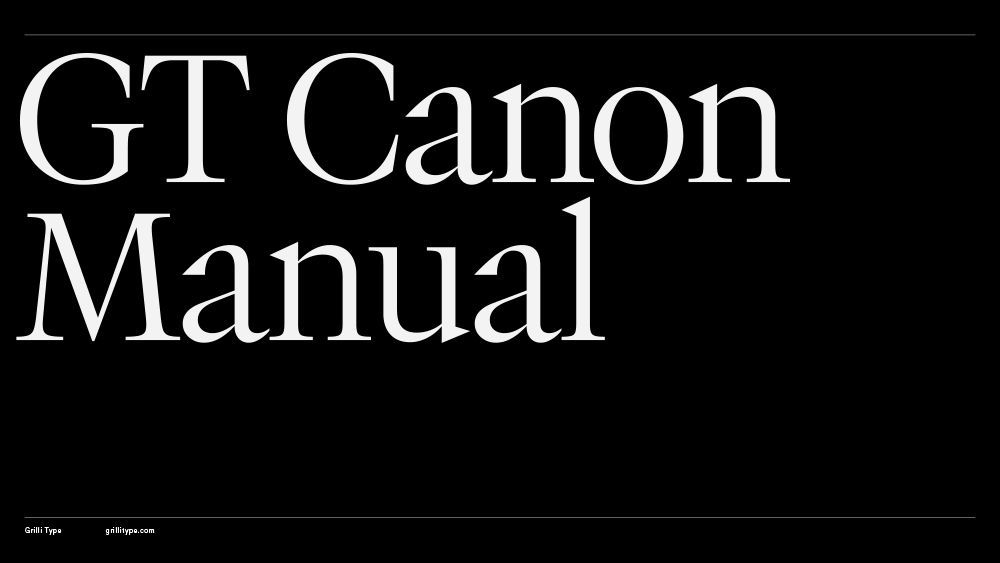
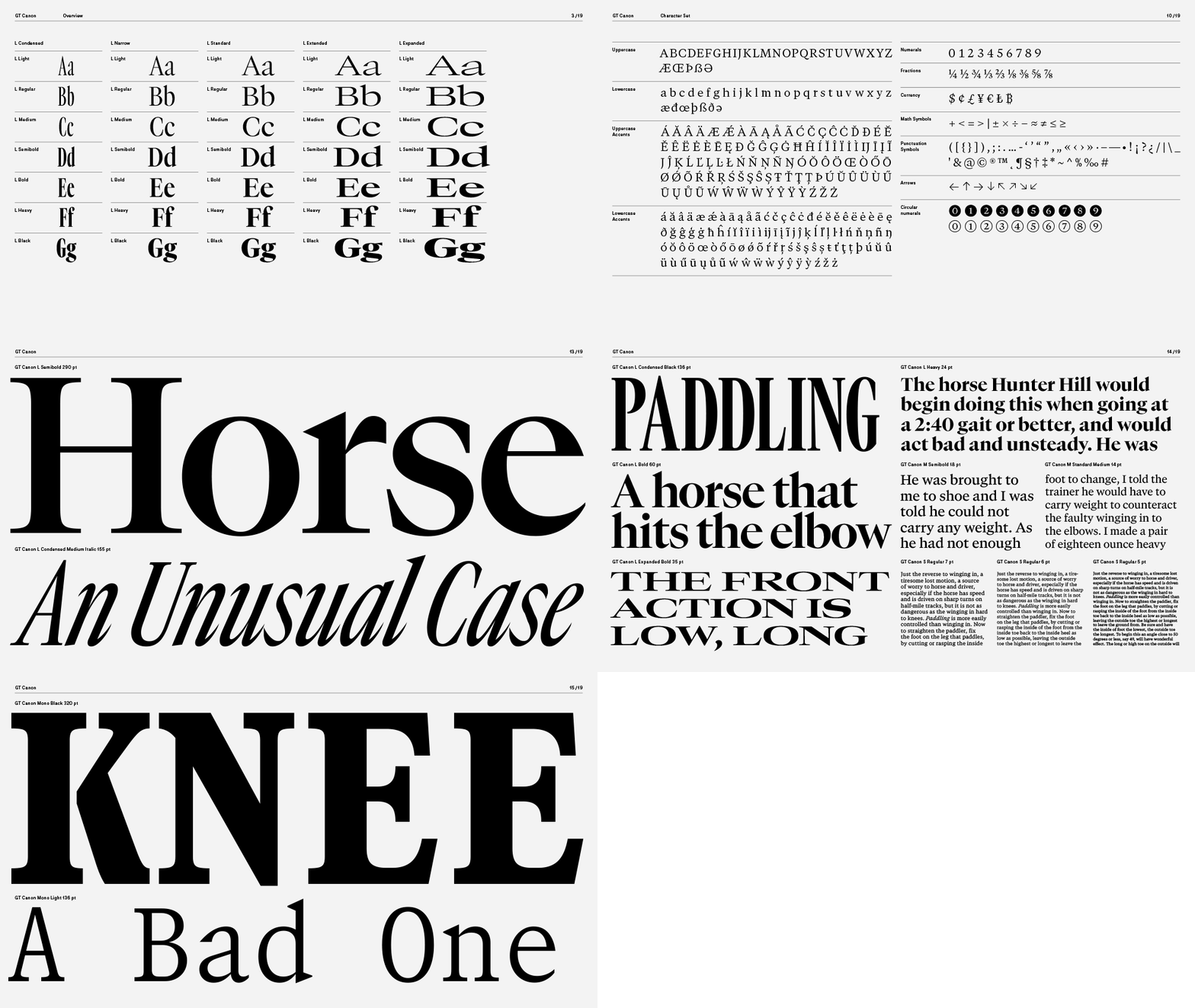
GT Canon’s design is pragmatic but not static: movement and liveliness are embedded in the letterforms. It is our answer to what our digital times require of a serif today. It’s what a contemporary serif should be in both form and function. Like its sans serif sibling, GT Standard, it aims for modern functionality rather than stylistic reinvention.
- Designed by Grilli Type
- Released in 2026
- Available in 224 styles
- GT Canon is available for customization and language extensions
- Download the free trial fonts
Typeface features
OpenType features enable smart typography. You can use these features in most Desktop applications, on the web, and in your mobile apps. Each typeface contains different features. Below are the most important features included in GT Canon’s fonts:
- TNUM
- Tabular figures
0123456789
- ONUM
- Oldstyle figures
0123456789
- SMCP
- Small Caps
Anatomy
Typeface Minisite
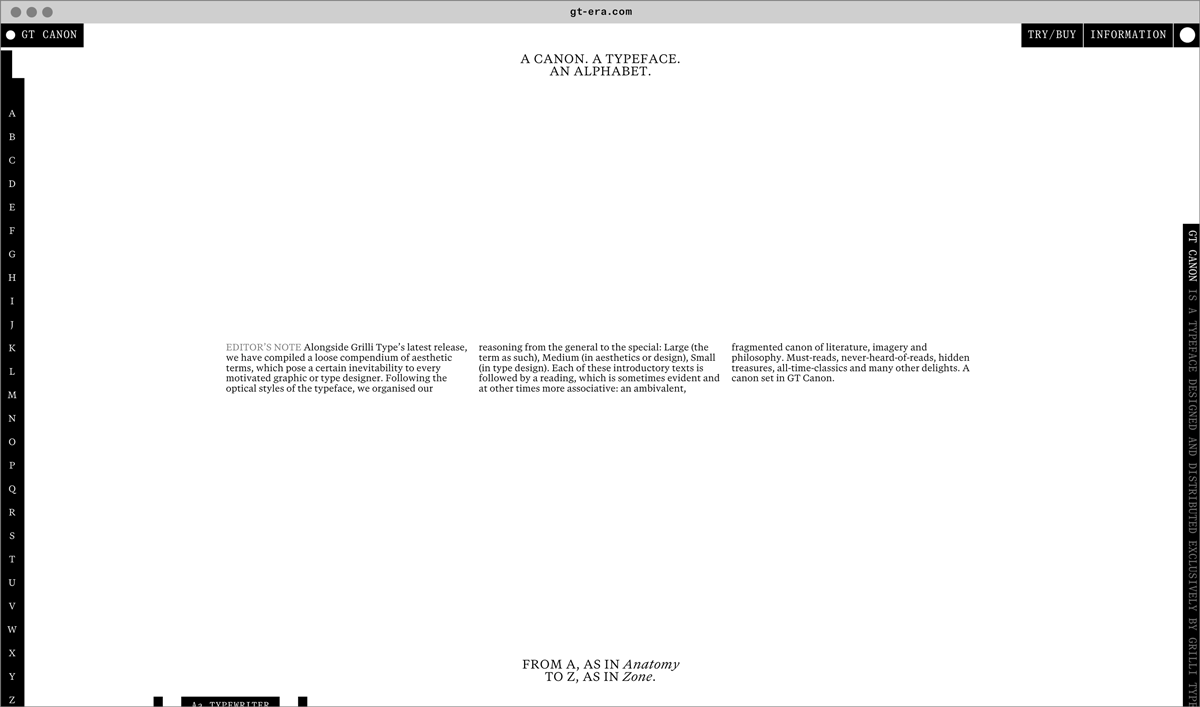
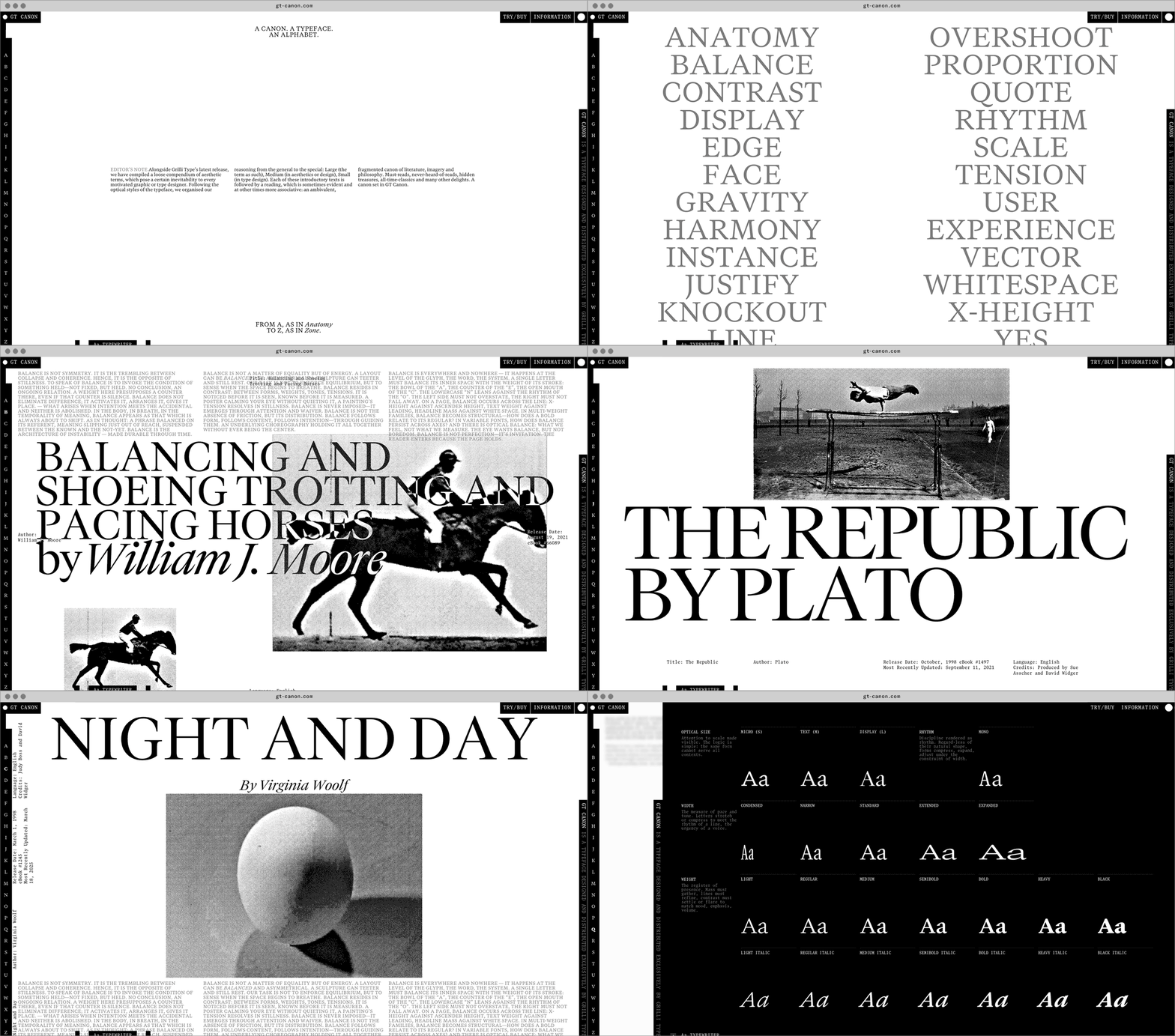
- Visit the GT Canon minisite to discover more about the typeface family’s history and design concept.
GT Canon in use