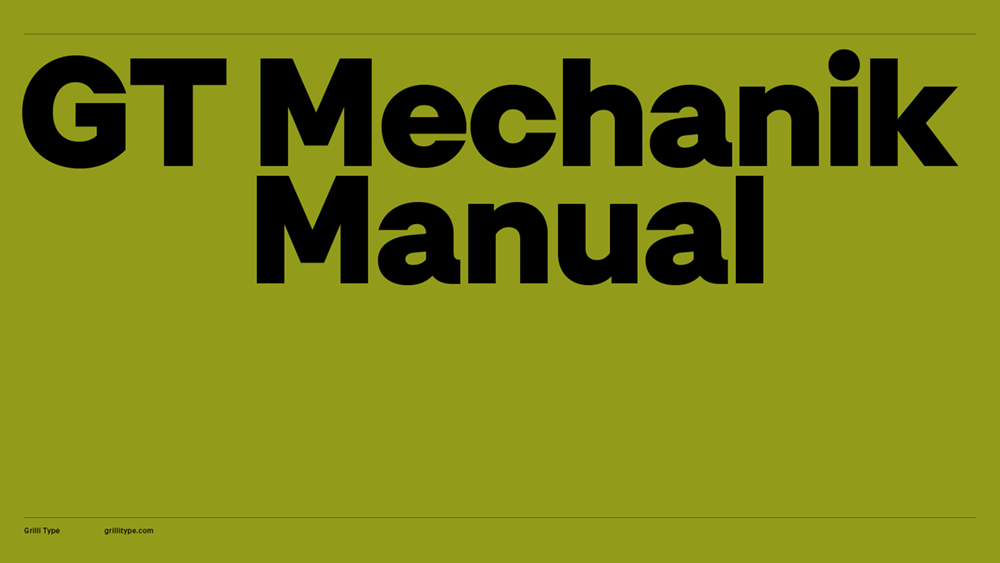
GT Mechanik

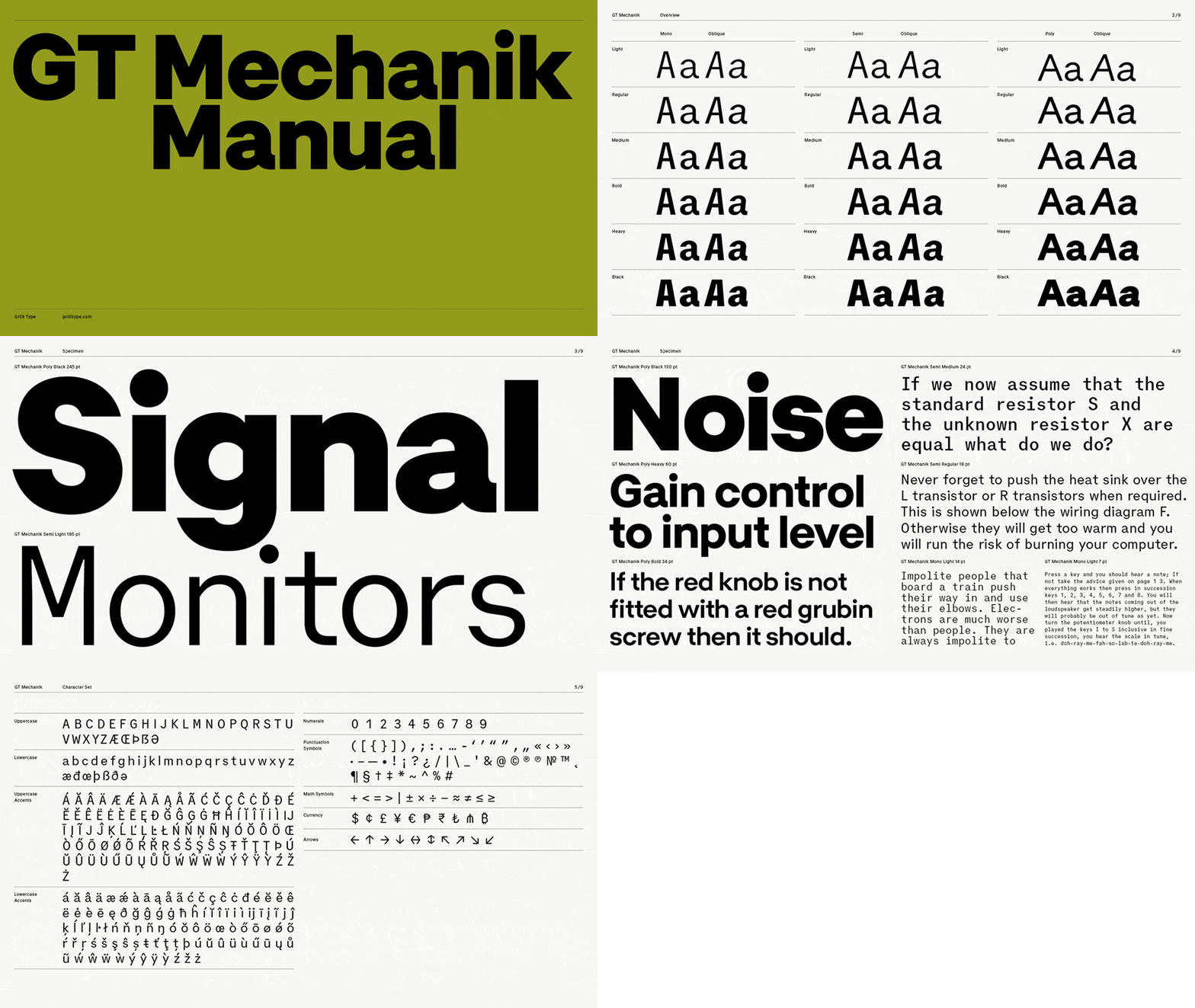
Family overview
- Mono
- Thin Oblique
- Light Oblique
- Regular Oblique
- Medium Oblique
- Bold Oblique
- Heavy Oblique
- Black Oblique
- Semi
- Thin Oblique
- Light Oblique
- Regular Oblique
- Medium Oblique
- Bold Oblique
- Heavy Oblique
- Black Oblique
- Poly
- Thin Oblique
- Light Oblique
- Regular Oblique
- Medium Oblique
- Bold Oblique
- Heavy Oblique
- Black Oblique
Subfamilies
- Semi ThinLOG ENTRY 1550 UTC records a moment as a discrete unit within a sequence, translating continuous duration into structured data that can be compared, stored, and referenced across systems.
- Semi Thin ObliqueResolution defines the smallest detectable difference within a system, determining the level of detail that can be represented without collapsing into indistinction or becoming unreadable.
- Semi LightNew signals exist as a distinction within a field of variation, emerging only when they can be separated from surrounding noise through conditions of reception that define what counts as meaningful difference within a given system.
- Semi Light ObliqueEvery signal is both singular and repeatable, defined by variation within a shared structure that enables recognition across instances while preserving difference.
- Semi RegularA 10–20–34 TONE sequence encodes information through ordered intervals, allowing meaning to emerge from relational differences rather than isolated values within the sequence.
- Semi Regular ObliqueNoise consists of accumulated variation that resists stable interpretation within a system, remaining inseparable from the signal it surrounds and therefore requiring management and filtering rather than complete elimination.
- Semi MediumScale divides continuity into discrete units, making variation countable while imposing structure on a field that would otherwise remain fluid and unbounded.
- Semi Medium ObliqueScale divides continuity into discrete units, making variation countable while imposing structure on a field that would otherwise remain fluid and unbounded.
- Semi BoldAt 088 units on the scale, deviation becomes visible while remaining within tolerance, indicating measurable difference without exceeding the operational limits that define system stability.
- Semi Bold ObliqueLOG ENTRY 1550 UTC records a moment as a discrete unit within a sequence, translating continuous duration into structured data that can be compared, stored, and referenced across systems.
- Semi HeavyDrift describes gradual deviation over time as a system moves away from its calibrated state, often imperceptible until accumulated to a degree that requires correction or recalibration.
- Semi Heavy ObliqueBecause 75 OHM impedance match aligns components within a transmission path to minimize reflection, ensuring continuity of signal across boundaries where mismatched conditions would otherwise produce loss.
- Semi BlackVoltage drop across a circuit reveals how resistance redistributes energy rather than simply diminishing it, making constraint an observable aspect of flow that defines how movement is shaped within the system.
- Semi Black ObliqueWaveform rendering time as visible form by tracing variation across an axis, allowing duration to be interpreted spatially and making pattern recognition possible through the continuity of its structure.
- Settings
Typeface information
GT Mechanik dials in the appeal of electromechanical text systems by building an inevitable family around its monospace style. Idiosyncratic features that come with the restraints of mechanic typesetting become guiding principles along the tone axis. Mono, Text and Display, each follow that logic at a different scale and intensity.
- Designed by Shiva Nallaperumal, Reto Moser, Noël Leu
- Released in 2026
- Available in 42 styles
- GT Mechanik is available for customization and language extensions
- Download the free trial fonts
Typeface features
OpenType features enable smart typography. You can use these features in most Desktop applications, on the web, and in your mobile apps. Each typeface contains different features. Below are the most important features included in GT Mechanik’s fonts:
- TNUM
- Tabular figures
0123456789
Typeface Minisite
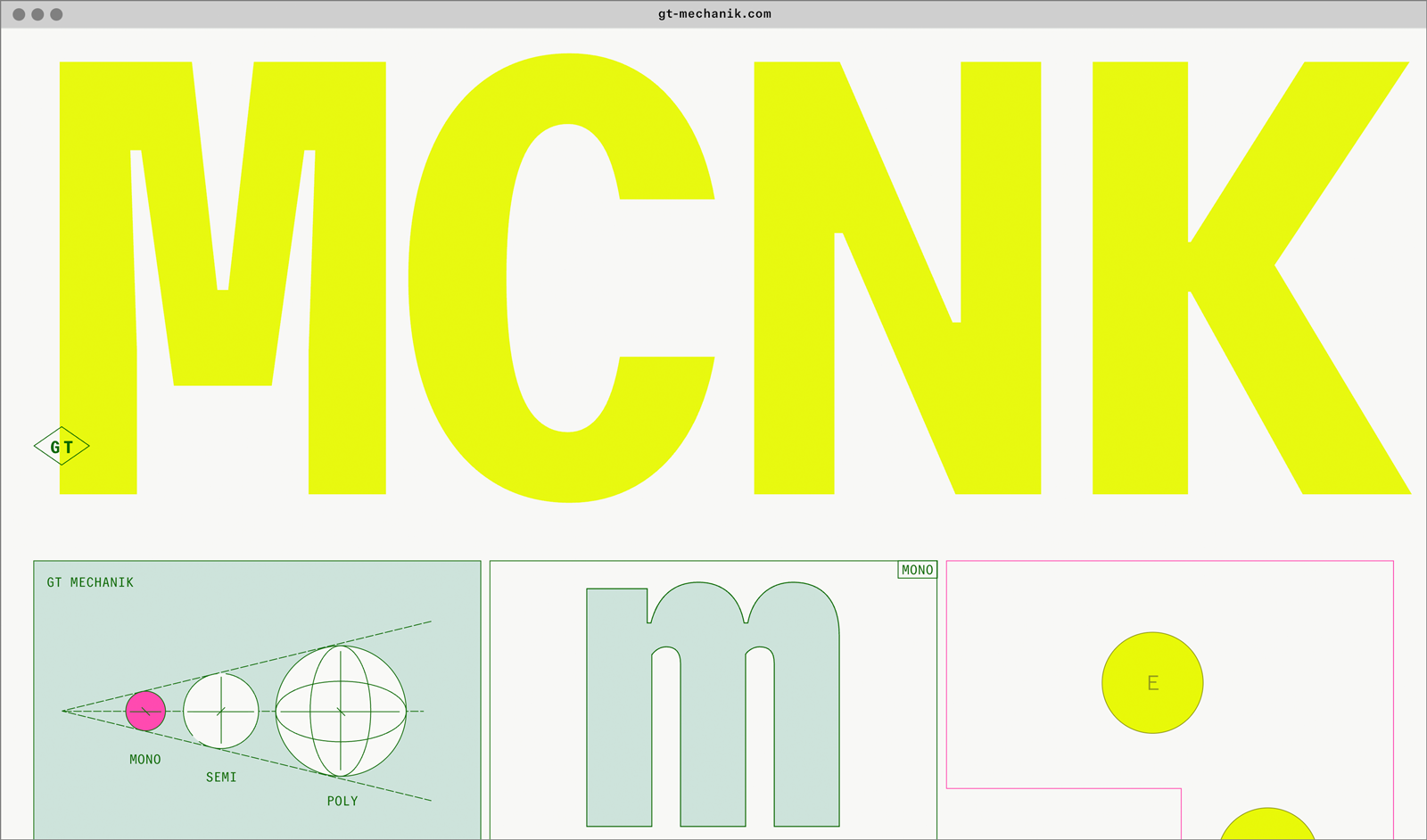
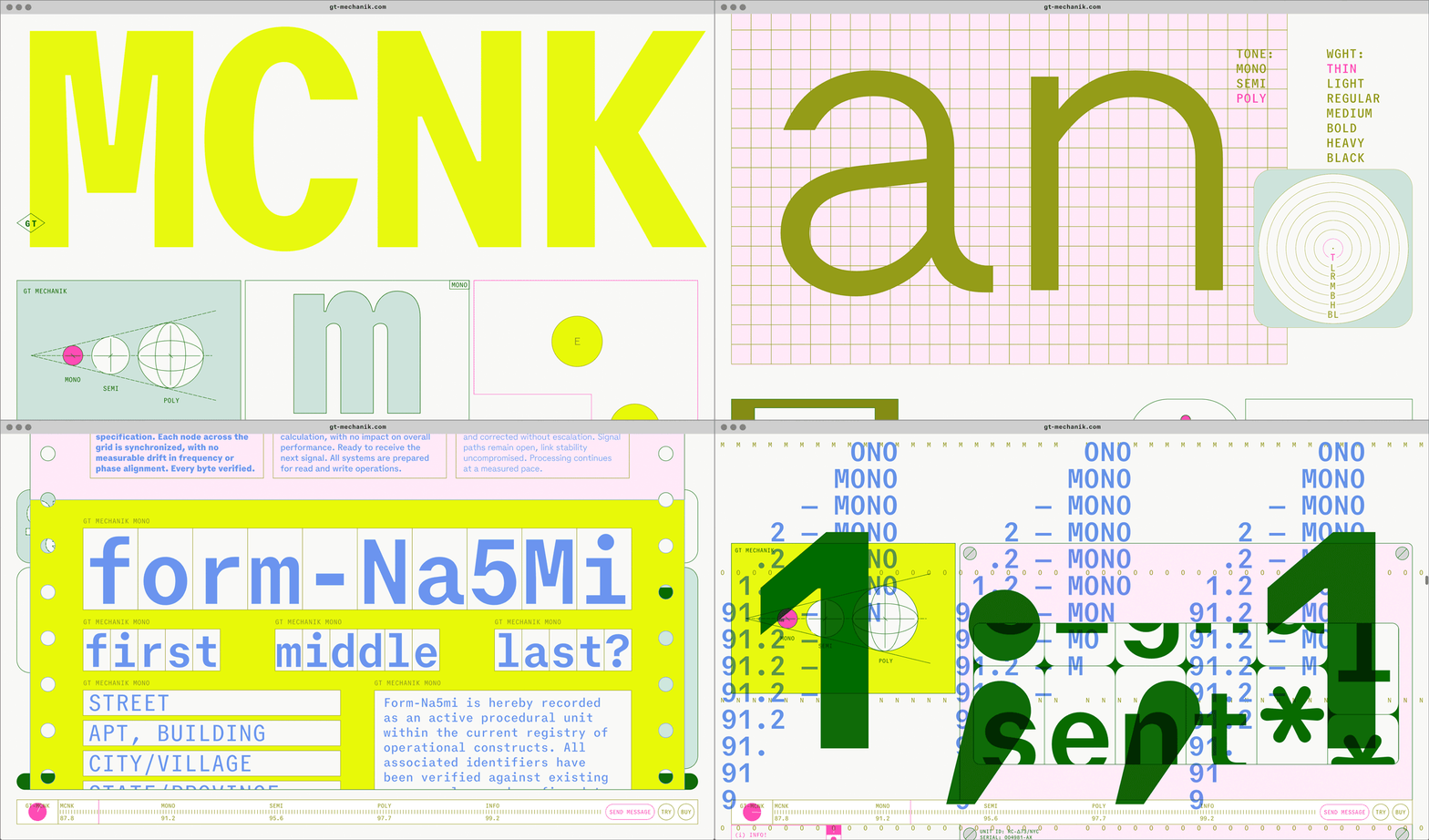
- Visit the GT Mechanik minisite to discover more about the typeface family’s history and design concept.