GT Cinetype

Family overview
  • Light Italic
  • Regular Italic
  • Bold Italic
  • Mono
  • Light
    The Room 2003 by Tommy Wiseau with Tommy Wiseau, Juliette Danielle, Greg Sestero
  • Light Italic
    Casablanca 1942 by Michael Curtiz with Humphrey Bogart, Ingrid Bergman, Paul Henreid
  • Regular
    Mononoke-hime 1997 by Hayao Miyazaki with Yôji Matsuda, Yuriko Ishida, Yûko Tanaka
  • Regular Italic
    Star Wars 1997 by George Lucas with Mark Hamill, Harrison Ford, Carrie Fisher
  • Bold
    The Human Centipede 2009 by Tom Six with Dieter Laser, Ashley C. Williams, Ashlynn Yennie
  • Bold Italic
    The Shawshank Redemption 1994 by Frank Darabont with Tim Robbins, Morgan Freeman, Bob Gunton
  • Mono
    The Toxic Avenger 1984 by Michael Herz & Lloyd Kaufman with Andree Maranda, Mitch Cohen, Jennifer Babtist
  • Settings
    Size
Typeface information

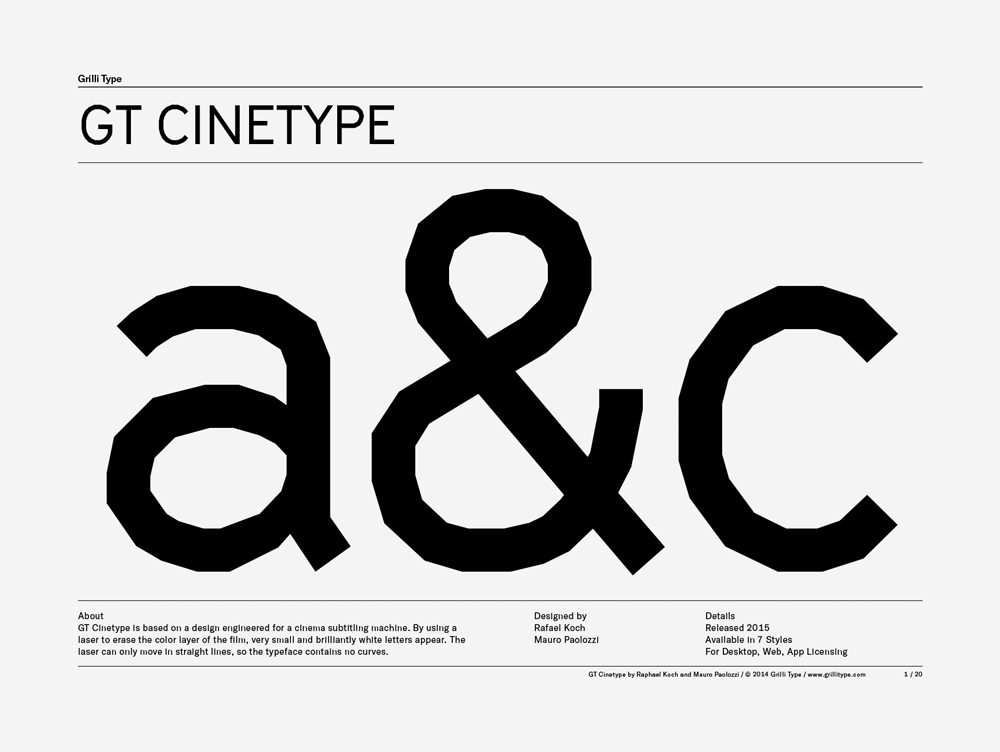
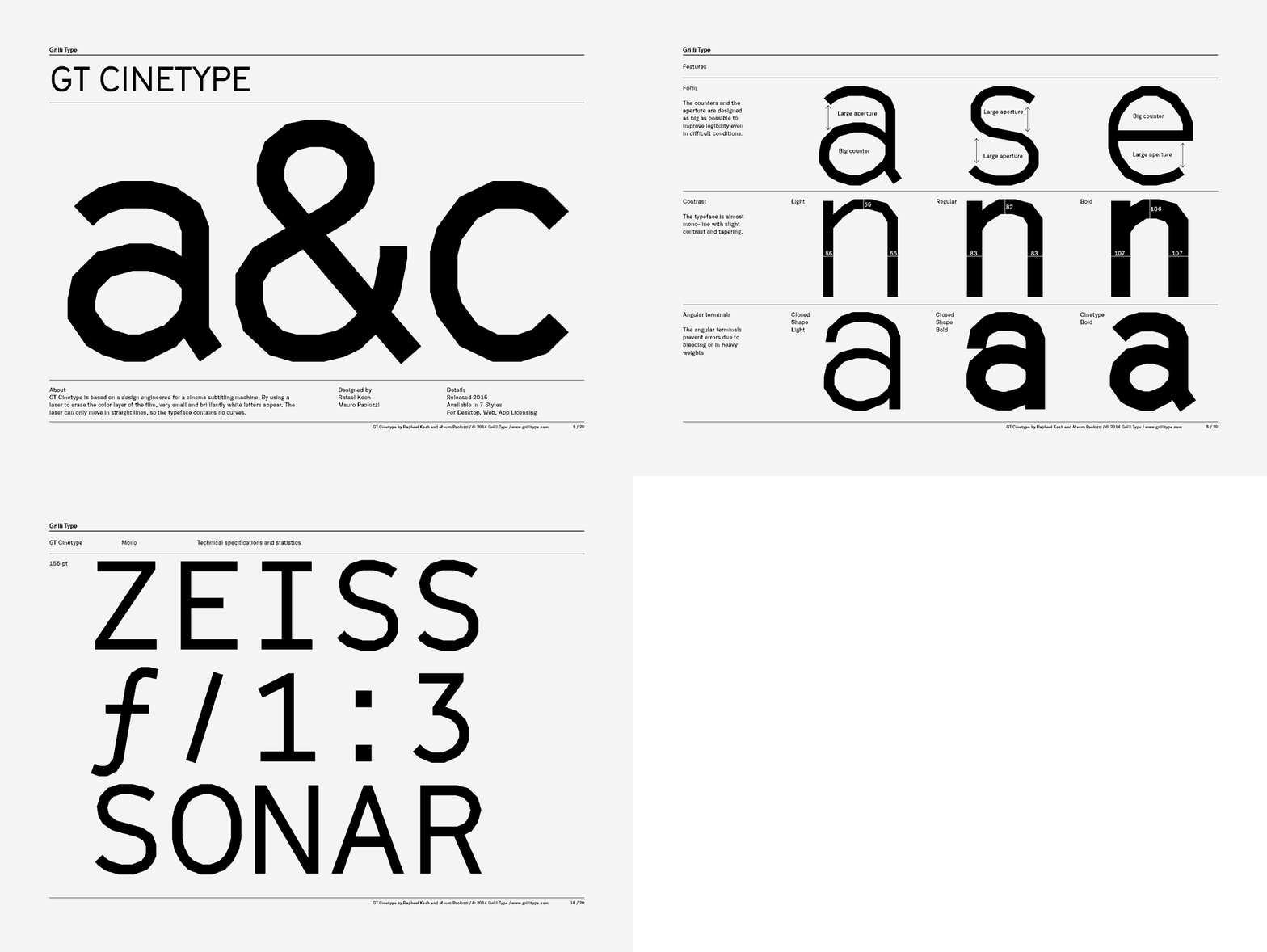
GT Cinetype is based on a design engineered for a cinema subtitling machine. By using a laser to erase the color layer of the film, very small and brilliantly white letters appear. The laser can only move in straight lines, so the typeface contains no curves.

Latin-alphabet languages: Afaan, Afar, Afrikaans, Albanian, Alsatian, Amis, Anuta, Aragonese, Aranese, Aromanian, Arrernte, Asturian, Atayal, Aymara, Azerbaijani, Basque, Belarusian, Bemba, Bikol, Bislama, Bosnian, Breton, Cape Verdean Creole, Catalan, Cebuano, Chamorro, Chavacano, Chichewa, Chickasaw, Cimbrian, Cofán, Cornish, Corsican, Creek, Croatian, Czech, Danish, Dawan, Dholuo, Drehu, Dutch, English, Estonian, Faroese, Fijian, Filipino, Finnish, French, Frisian, Friulian, Galician, Ganda, Genoese, German, Gikuyu, Gooniyandi, Greenlandic (Kalaallisut), Guadeloupean Creole, Gwich’in, Haitian Creole, Hawaiian, Hiligaynon, Hopi, Hungarian, Icelandic, Ido, Igbo, Ilocano, Indonesian , Irish, Istro-Romanian, Italian, Jamaican, Javanese, Jèrriais, Kaingang, Kala Lagaw Ya, Kapampangan, Kaqchikel, Kashubian, Kikongo, Kinyarwanda, Kiribati, Kirundi, Kurdish, Ladin, Latin, Latvian, Lithuanian, Lombard, Low Saxon, Luxembourgish, Maasai, Makhuwa, Malay, Maltese, Manx, Māori, Marquesan, Megleno-Romanian, Meriam Mir, Mirandese, Mohawk, Moldovan, Montagnais, Montenegrin, Murrinh-Patha, Nagamese Creole, Nahuatl, Ndebele, Neapolitan, Niuean, Noongar, Norwegian, Occitan, Old Icelandic, Old Norse, Oshiwambo, Palauan, Papiamento, Piedmontese, Polish, Portuguese, Q’eqchi’, Quechua, Rarotongan, Romanian, Romansh, Rotokas, Inari Sami, Lule Sami, Northern Sami, Southern Sami, Samoan, Sango, Saramaccan, Sardinian, Scottish Gaelic, Seri, Seychellois Creole, Shawnee, Shona, Sicilian, Silesian, Slovak, Slovenian, Somali, Upper and Lower Sorbian, Northern and Southern Sotho, Spanish, Sranan, Sundanese, Swahili, Swazi, Swedish, Tagalog, Tahitian, Tetum, Tok Pisin, Tokelauan, Tongan, Tshiluba, Tsonga, Tswana, Tumbuka, Turkish, Tuvaluan, Tzotzil, Venetian, Vepsian, Võro, Wallisian, Walloon, Waray-Waray, Warlpiri, Wayuu, Welsh, Wik-Mungkan, Wolof, Xavante, Xhosa, Yapese, Yindjibarndi, Zapotec, Zarma, Zazaki, Zulu, Zuni

Typeface features

OpenType features enable smart typography. You can use these features in most Desktop applications, on the web, and in your mobile apps. Each typeface contains different features. Below are the most important features included in GT Cinetype’s fonts:

  • CASE
  • Case sensitive forms
(ROBOCOP)
  • ONUM
  • Oldstyle figures
10.03.1985
Typeface Minisite
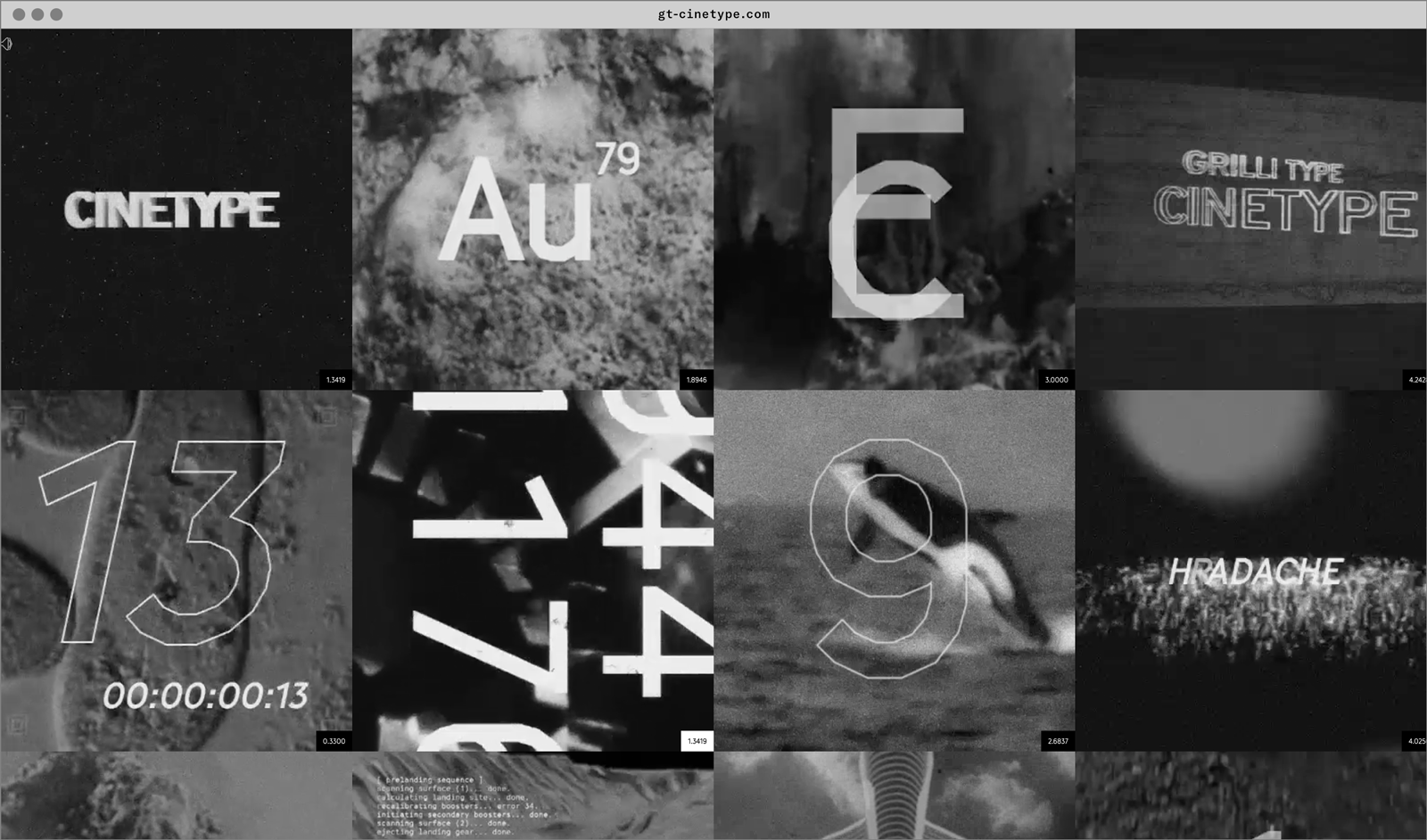
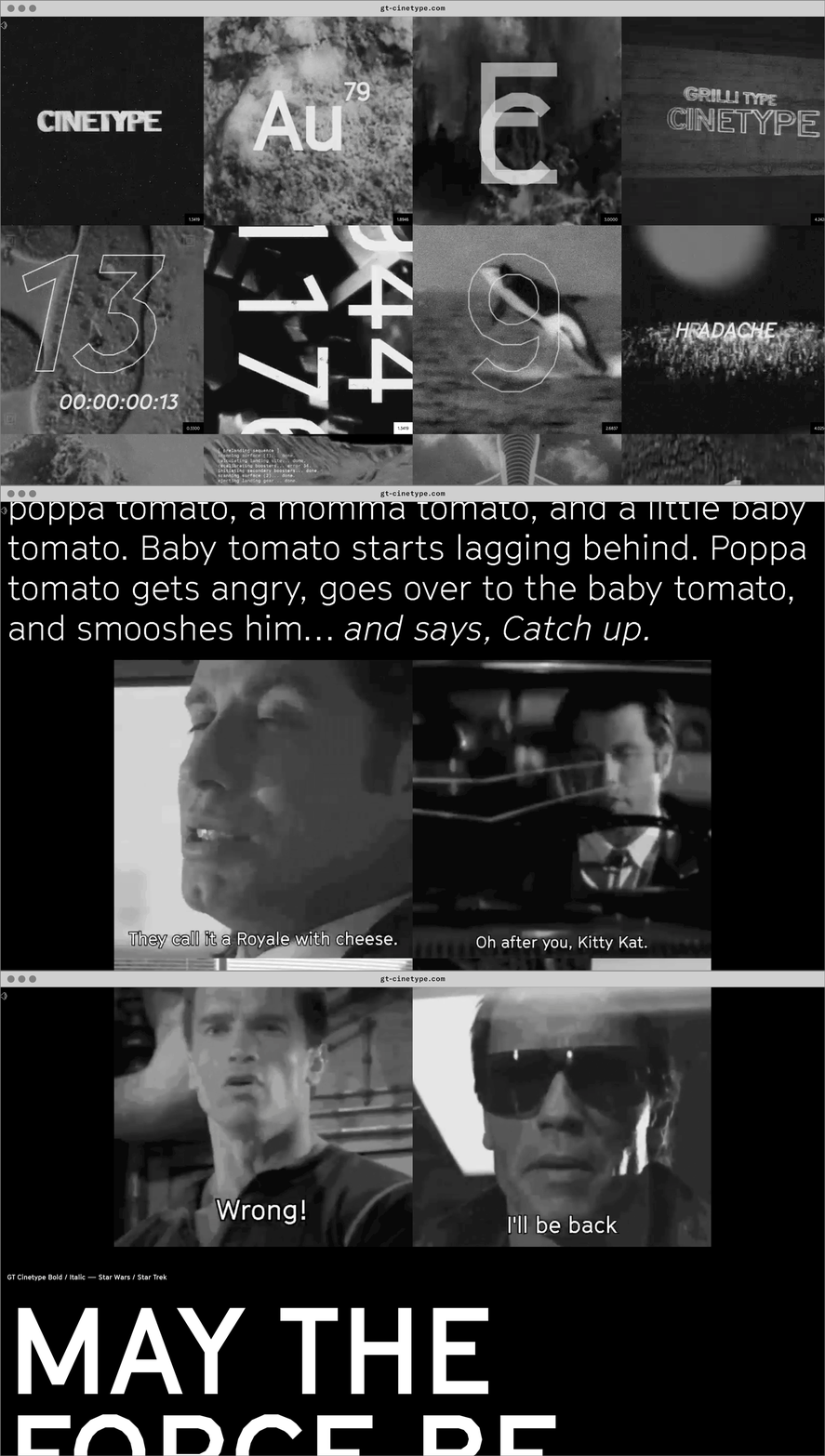
  • Visit the GT Cinetype minisite to discover more about the typeface family’s history and design concept.
GT Cinetype in use