GT Standard

Family overview
- Compressed
- S Light Oblique
- M Light Oblique
- L Light Oblique
- S Regular Oblique
- M Regular Oblique
- L Regular Oblique
- S Medium Oblique
- M Medium Oblique
- L Medium Oblique
- S Semibold Oblique
- M Semibold Oblique
- L Semibold Oblique
- S Bold Oblique
- M Bold Oblique
- L Bold Oblique
- S Heavy Oblique
- M Heavy Oblique
- L Heavy Oblique
- S Black Oblique
- M Black Oblique
- L Black Oblique
- Condensed
- S Light Oblique
- M Light Oblique
- L Light Oblique
- S Regular Oblique
- M Regular Oblique
- L Regular Oblique
- S Medium Oblique
- M Medium Oblique
- L Medium Oblique
- S Semibold Oblique
- M Semibold Oblique
- L Semibold Oblique
- S Bold Oblique
- M Bold Oblique
- L Bold Oblique
- S Heavy Oblique
- M Heavy Oblique
- L Heavy Oblique
- S Black Oblique
- M Black Oblique
- L Black Oblique
- Narrow
- S Light Oblique
- M Light Oblique
- L Light Oblique
- S Regular Oblique
- M Regular Oblique
- L Regular Oblique
- S Medium Oblique
- M Medium Oblique
- L Medium Oblique
- S Semibold Oblique
- M Semibold Oblique
- L Semibold Oblique
- S Bold Oblique
- M Bold Oblique
- L Bold Oblique
- S Heavy Oblique
- M Heavy Oblique
- L Heavy Oblique
- S Black Oblique
- M Black Oblique
- L Black Oblique
- Standard
- S Light Oblique
- M Light Oblique
- L Light Oblique
- S Regular Oblique
- M Regular Oblique
- L Regular Oblique
- S Medium Oblique
- M Medium Oblique
- L Medium Oblique
- S Semibold Oblique
- M Semibold Oblique
- L Semibold Oblique
- S Bold Oblique
- M Bold Oblique
- L Bold Oblique
- S Heavy Oblique
- M Heavy Oblique
- L Heavy Oblique
- S Black Oblique
- M Black Oblique
- L Black Oblique
- Extended
- S Light Oblique
- M Light Oblique
- L Light Oblique
- S Regular Oblique
- M Regular Oblique
- L Regular Oblique
- S Medium Oblique
- M Medium Oblique
- L Medium Oblique
- S Semibold Oblique
- M Semibold Oblique
- L Semibold Oblique
- S Bold Oblique
- M Bold Oblique
- L Bold Oblique
- S Heavy Oblique
- M Heavy Oblique
- L Heavy Oblique
- S Black Oblique
- M Black Oblique
- L Black Oblique
- Expanded
- Mono Compressed
- Light Oblique
- Regular Oblique
- Medium Oblique
- Semibold Oblique
- Bold Oblique
- Heavy Oblique
- Black Oblique
- Mono Condensed
- Light Oblique
- Regular Oblique
- Medium Oblique
- Semibold Oblique
- Bold Oblique
- Heavy Oblique
- Black Oblique
- Mono Narrow
- Light Oblique
- Regular Oblique
- Medium Oblique
- Semibold Oblique
- Bold Oblique
- Heavy Oblique
- Black Oblique
- Mono Standard
- Light Oblique
- Regular Oblique
- Medium Oblique
- Semibold Oblique
- Bold Oblique
- Heavy Oblique
- Black Oblique
- Mono Extended
- Light Oblique
- Regular Oblique
- Medium Oblique
- Semibold Oblique
- Bold Oblique
- Heavy Oblique
- Black Oblique
- Mono Expanded
Subfamilies
- Standard S LightMicrosoft Word DOC. Due to the market dominance of Word, it is supported by all office applications that intend to compete with it, typically by reverse engineering the undocumented file format.
- Standard M LightThere are many examples of de facto consolidation of a standard by market forces and competition, in a two-sided market, after a dispute, for example with VHS and Betamax in the videotape format war.
- Standard L LightThe people who use the item or service (engineers, trade unions, etc.) or specify it (building codes, government, industry, etc.) have the responsibility to consider the available standards, specify the correct one, enforce compliance, and use the item correctly.
- Standard S Light ObliquePrivate standards are developed by private entities such as companies, non-governmental organizations or private sector multi-stakeholder initiatives, also referred to as multistakeholder governance.
- Standard M Light ObliqueA standard practice or procedure gives a set of instructions for performing operations or functions. For example, there are detailed standard operating procedures for operation of a nuclear power plant.
- Standard L Light ObliqueStandards often get reviewed, revised and updated on a regular basis. It is critical that the most current version of a published standard be used or referenced.
- Standard S RegularWith the Acrobat Reader program available for free, and continued support of the format, PDF eventually became the de facto standard for printable documents. In 2005, PDF/A became a de jure standard as ISO 19005-1:2005.[4] In 2008 Adobe's PDF 1.7 became ISO 32000-1:2008.
- Standard M RegularThe ANSI for eye protection is Z87.1, which gives a specific impact resistance rating to the eyewear. This standard is commonly used for shop glasses, shooting glasses, and many other examples of protective eyewear.
- Standard L RegularStandards often get reviewed, revised and updated on a regular basis. It is critical that the most current version of a published standard be used or referenced.
- Standard S Regular ObliqueMicrosoft has repeatedly internally changed the file specification between versions of Word to suit their own needs, while continuing to reuse the same file extension identifier for different versions.
- Standard M Regular ObliqueThe existence of a published standard does not imply that it is always useful or correct. For example, if an item complies with a certain standard, there is not necessarily assurance that it is fit for any particular use.
- Standard L Regular ObliqueTechnical standards may exist as public documents on the internet, public library, etc. Some technical standards may be found at a major central library or at the library of a good technical university
- Standard S MediumThere are many different standards in many fields of daily life. Standards are important so that correct comparisons can be produced.
- Standard M MediumStandards often get reviewed, revised and updated on a regular basis. It is critical that the most current version of a published standard be used or referenced.
- Standard L MediumBNC for medium frequency signal in electronic engineering testing (commonly used by signal generators, oscilloscopes, multimeters, etc.) and sometimes in video signal delivery between devices in studios and other professional settings.
- Standard S Medium ObliqueA technical standard may be developed privately or unilaterally, for example by a corporation, regulatory body, military, etc. Standards can also be developed by groups such as trade unions and trade associations.
- Standard M Medium ObliqueANSI's market-driven, decentralized approach has been criticized in comparison with more planned and organized international approaches to standardization.
- Standard L Medium ObliqueThe MP3 audio format started as an alternative to WAV for internet music distribution, then replaced it. It is now supported by the vast majority of music players, audio transport, audio storage, and non-commercial media.
- Standard S SemiboldPhone connector (3.5 mm jack), RCA and XLR connectors, used in the audio industry for connecting audio equipment such as headphones, mixing desks, microphones, stage lighting, etc.
- Standard M SemiboldAccording to Adam Stanton, the first permanent secretary and head of staff in 1919, AESC started as an ambitious program and little else. Staff for the first year consisted of one executive, Clifford B. LePage, who was on loan from a founding member, ASME.
- Standard L SemiboldPCI Express electrical and mechanical interface, and interconnect protocol used in computers, servers, and industrial applications.
- Standard S Semibold ObliqueA technical standard includes definition of terms; classification of components; delineation of procedures; specification of dimensions, materials, performance, designs, or operations; measurement of quality and quantity in describing materials, processes, products, systems, services, or practices; test methods and sampling procedures; or descriptions of fit and measurements of size or strength.
- Standard M Semibold ObliqueTeX typesetting system, commonly used in creating scientific articles and reports for publication (in fact many journals require the publication to be fully written in TeX)
- Standard L Semibold ObliquePCI Express electrical and mechanical interface, and interconnect protocol used in computers, servers, and industrial applications.
- Standard S BoldIn social sciences a voluntary standard that is also a de facto standard is a typical solution to a coordination problem. The choice of a de facto standard tends to be stable in situations in which all parties can realize mutual gains, but only by making mutually consistent decisions. In contrast, an enforced de jure standard is a solution to the prisoner's problem.
- Standard M BoldStandards organizations often have more diverse input and usually develop voluntary standards: these might become mandatory if adopted by a government (i.e., through legislation), business contract, etc.
- Standard L BoldMicrosoft Word DOC. Due to the market dominance of Word, it is supported by all office applications that intend to compete with it, typically by reverse engineering the undocumented file format.
- Standard S Bold ObliqueThe IBM Personal Computer: by one year after its 1981 release, John Dvorak described the PC as rapidly becoming a de facto standard microcomputer. With the MS-DOS and Microsoft Windows operating systems, it gained a large share of the personal computer market.
- Standard M Bold ObliqueThe American National Standards Institute is a private nonprofit organization that oversees the development of voluntary consensus standards for products, services, processes, systems, and personnel in the United States.
- Standard L Bold ObliquePrivate standards are developed by private entities such as companies, non-governmental organizations or private sector multi-stakeholder initiatives, also referred to as multistakeholder governance.
- Standard S HeavyThe people who use the item or service (engineers, trade unions, etc.) or specify it (building codes, government, industry, etc.) have the responsibility to consider the available standards, specify the correct one, enforce compliance, and use the item correctly.
- Standard M HeavyThe ANSI for eye protection is Z87.1, which gives a specific impact resistance rating to the eyewear. This standard is commonly used for shop glasses, shooting glasses, and many other examples of protective eyewear.
- Standard L HeavyA de facto standard is a custom or convention that is commonly used even though its use is not required. De facto is a Latin phrase meaning in practice but not necessarily ordained by law, or in practice or actuality, but not officially established.
- Standard S Heavy ObliqueVoluntary consensus standards quicken the market acceptance of products while making clear how to improve the safety of those products for the protection of consumers.
- Standard M Heavy ObliqueThere are many examples of de facto consolidation of a standard by market forces and competition, in a two-sided market, after a dispute, for example with VHS and Betamax in the videotape format war.
- Standard L Heavy ObliqueThere are many examples of de facto consolidation of a standard by market forces and competition, in a two-sided market, after a dispute, for example with VHS and Betamax in the videotape format war.
- Standard S BlackDMX512 (commonly just DMX) with XLR connector to control and sometimes power stage and venue lights, effects, smoke machines, laser projectors, and pyrotechnics.
- Standard M BlackA technical standard may be developed privately or unilaterally, for example by a corporation, regulatory body, military, etc. Standards can also be developed by groups such as trade unions and trade associations.
- Standard L BlackA technical standard may be developed privately or unilaterally, for example by a corporation, regulatory body, military, etc. Standards can also be developed by groups such as trade unions and trade associations.
- Standard S Black ObliqueBNC for medium frequency signal in electronic engineering testing (commonly used by signal generators, oscilloscopes, multimeters, etc.) and sometimes in video signal delivery between devices in studios and other professional settings.
- Standard M Black ObliqueFor example, there may be a specification for a turbine blade for a jet engine that defines the exact material and performance requirements.
- Standard L Black Oblique2.54 mm (0.1 inch) pin spacing on many electronic components, including DIP, SIL packages, header connectors, and many more. The standard spacing enable use of these devices in prototyping boards and standardized sockets.
- Settings
Typeface information
GT Standard is a contemporary response to the modernist pursuit of standardization. It’s rooted in the principles of Swiss Style and expands on this legacy to meet the needs of today’s visual landscape. The typeface is systematic yet expressive, built for clarity, adaptability, and precision across every scale and medium.
- Designed by Grilli Type
- Released in 2025
- Available in 336 styles
- GT Standard is available for customization and language extensions
- Download the free trial fonts


Typeface features
OpenType features enable smart typography. You can use these features in most Desktop applications, on the web, and in your mobile apps. Each typeface contains different features. Below are the most important features included in GT Standard’s fonts:
- SS01
- Alternate a
Regards
- SS02
- Alternate g
Engaging
- SS03
- Alternate y
Energy
- SS04
- Alternate Q
Quality
- SS06
- Rectangular Dots
Minimalism
- SS07
- Account Spoofing
Informal
Typeface Minisite
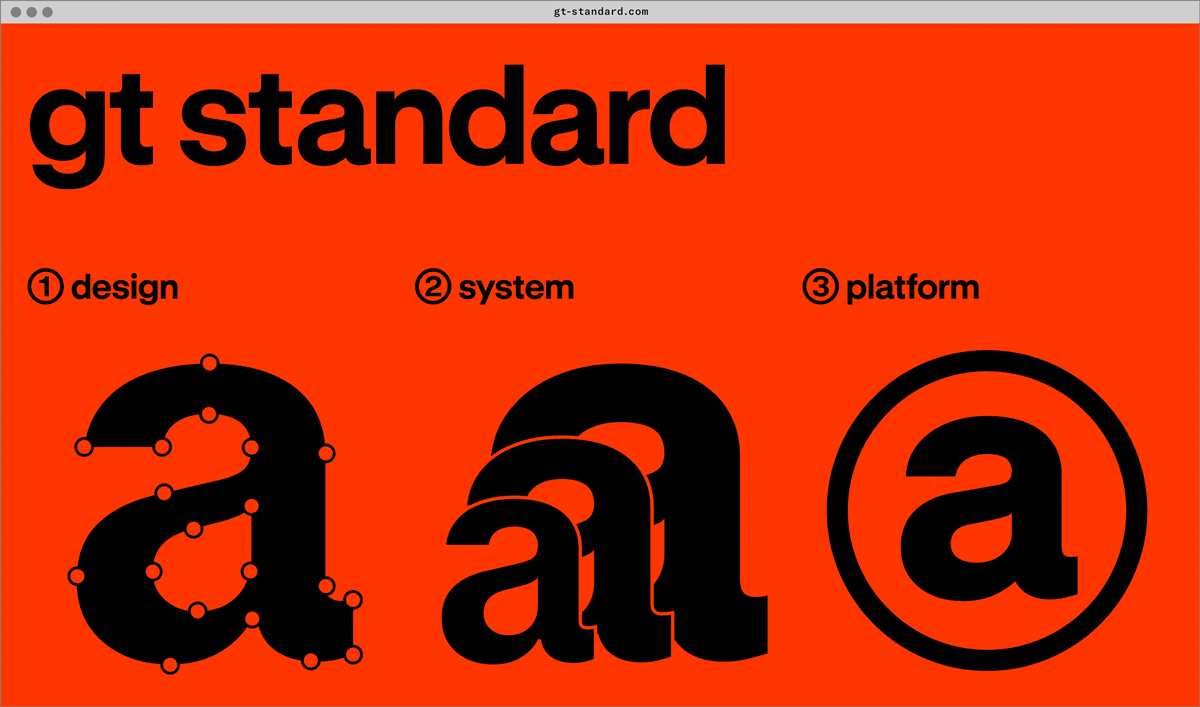
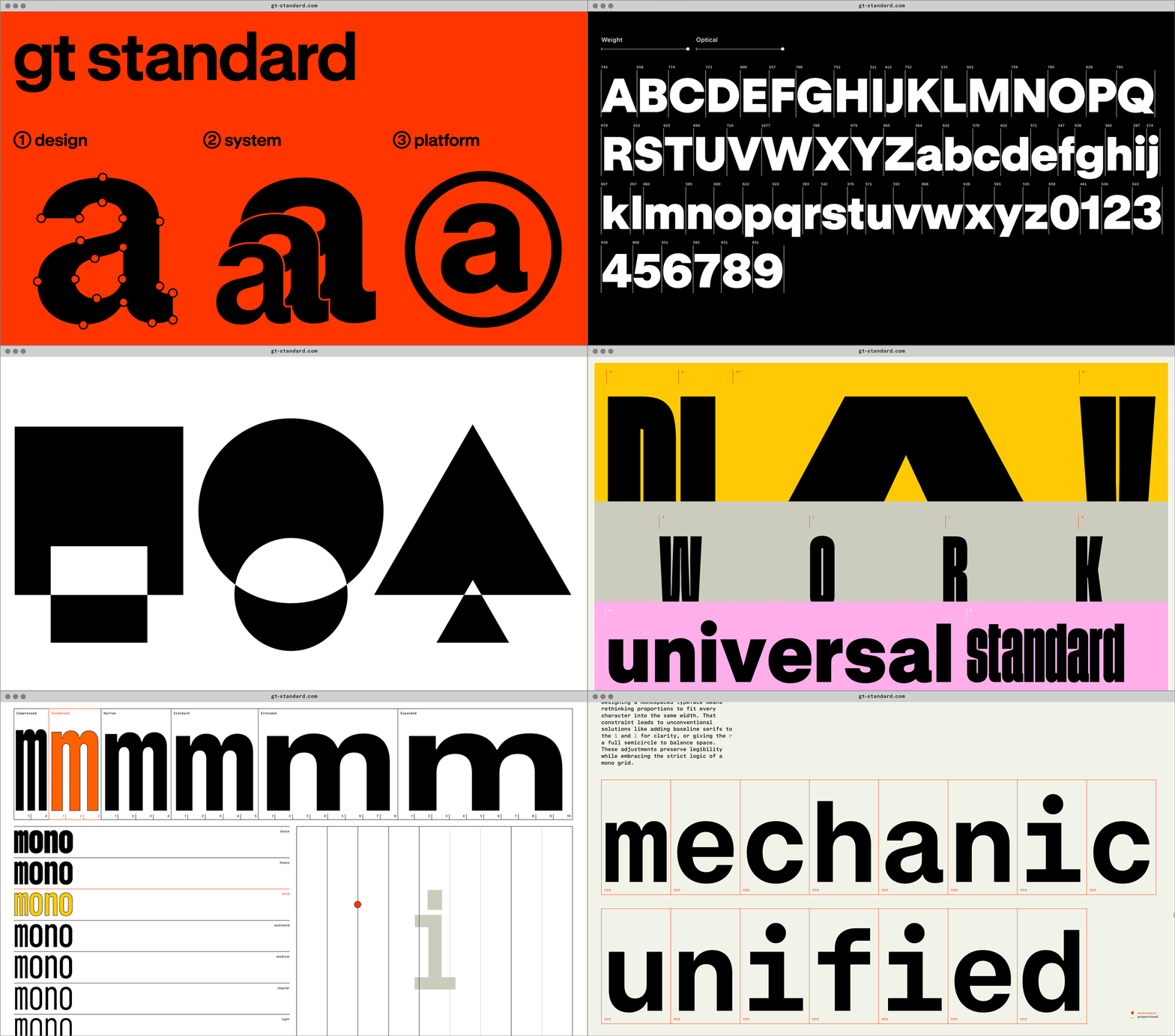
- Visit the GT Standard minisite to discover more about the typeface family’s history and design concept.
GT Standard in use