GT Alpina

Family overview
- Condensed
- Thin Italic
- Light Italic
- Regular Italic
- Medium Italic
- Bold Italic
- Standard
- Thin Italic
- Light Italic
- Regular Italic
- Medium Italic
- Bold Italic
- Extended
- Thin Italic
- Light Italic
- Regular Italic
- Medium Italic
- Bold Italic
- Fine Condensed
- Thin Italic
- Light Italic
- Regular Italic
- Medium Italic
- Bold Italic
- Fine Standard
- Thin Italic
- Light Italic
- Regular Italic
- Medium Italic
- Bold Italic
- Fine Extended
- Thin Italic
- Light Italic
- Regular Italic
- Medium Italic
- Bold Italic
- Typewriter
- Thin Italic
- Light Italic
- Regular Italic
- Medium Italic
- Bold Italic
Subfamilies
- Standard ThinThe next Himalayan Indian state, Himachal Pradesh, it is noted for its hill stations, particularly Shimla, the summer capital
- Standard Thin ItalicWildlife such as ibex live in the higher peaks to elevations of 3,400 m (11,155 ft), and plants such as Edelweiss grow in rocky areas in lower elevations as well as in higher elevations
- Standard LightThe Matterhorn hut was built in 1865, the Mountet in 1871, the Weisshorn Hut in 1876, the Concordia on the Aletsch glacier and the Boval hut in 1877.
- Standard Light Italic1:25.000 This is the most detailed map, useful for many purposes. Those are popular with tourists, especially for famous areas like Zermatt and St. Moritz.
- Standard RegularNorgay had reached 8,595 m (28,199 ft) the previous year as a member of the 1952 Swiss expedition.
- Standard Regular ItalicThe altitude and size of the range affects the climate in Europe; in the mountains precipitation levels vary greatly and climatic conditions consist of distinct zones
- Standard MediumThe first hut, known under the name Betemps hut, was built between 1894 and 1895. It had 25 beds and was owned by the Swiss Alpine Club central committee.
- Standard Medium ItalicLoretan was the third person to have climbed all 14 eight-thousanders, a feat he accomplished at the age of 36
- Standard BoldRoch was born near Geneva, Switzerland in 1906, the son of an academic physician who would later become the president of the University of Geneva.
- Standard Bold ItalicWildlife such as ibex live in the higher peaks to elevations of 3,400 m (11,155 ft), and plants such as Edelweiss grow in rocky areas in lower elevations as well as in higher elevations
- Settings
Typeface information
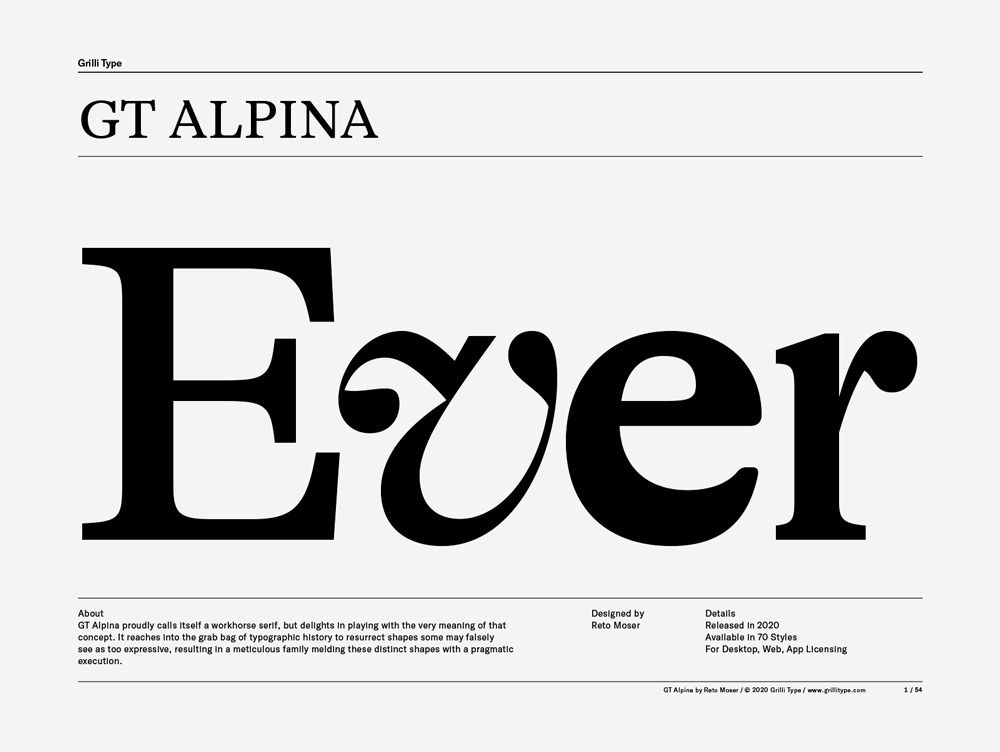
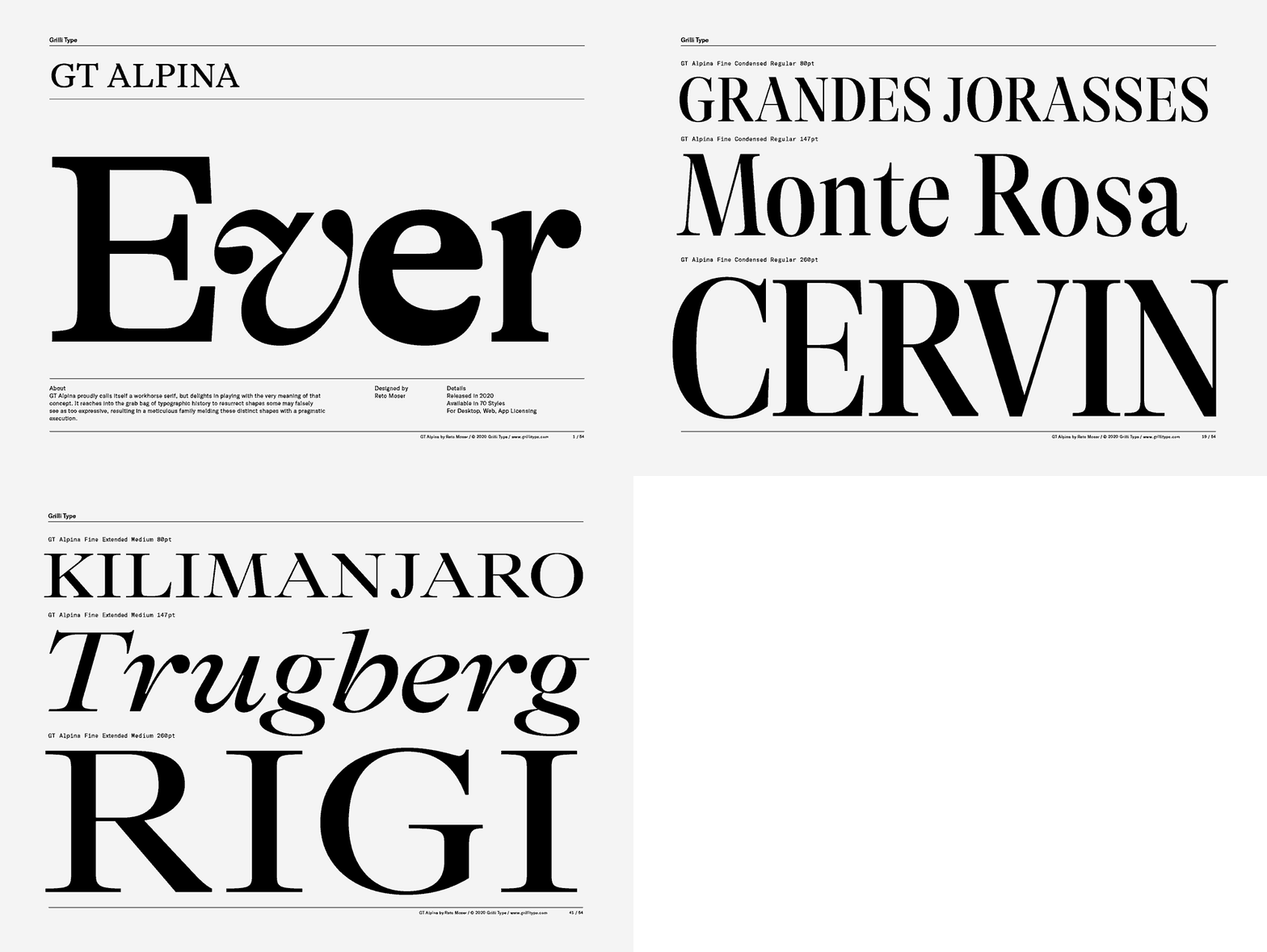
GT Alpina proudly calls itself a workhorse serif, but delights in playing with the very meaning of that concept. It reaches into the grab bag of typographic history to resurrect shapes some may falsely see as too expressive, resulting in a meticulous family melding these distinct shapes with a pragmatic execution.
- Designed by Reto Moser
- Released in 2020
- Available in 70 styles
- GT Alpina is available for customization and language extensions
- Download the free trial fonts
Typeface features
OpenType features enable smart typography. You can use these features in most Desktop applications, on the web, and in your mobile apps. Each typeface contains different features. Below are the most important features included in GT Alpina’s fonts:
- SS01
- Alternate J
Jungfrau
- SS02
- Alternate ?
¿Ascensión?
- SS03
- Alternate &
Piz & Palü
- SS04
- Alternate @
M@terhorn
- ONUM
- Oldstyle Figures
0123456789
- SMCP
- Small Caps
Greina Pass
Typeface Minisite
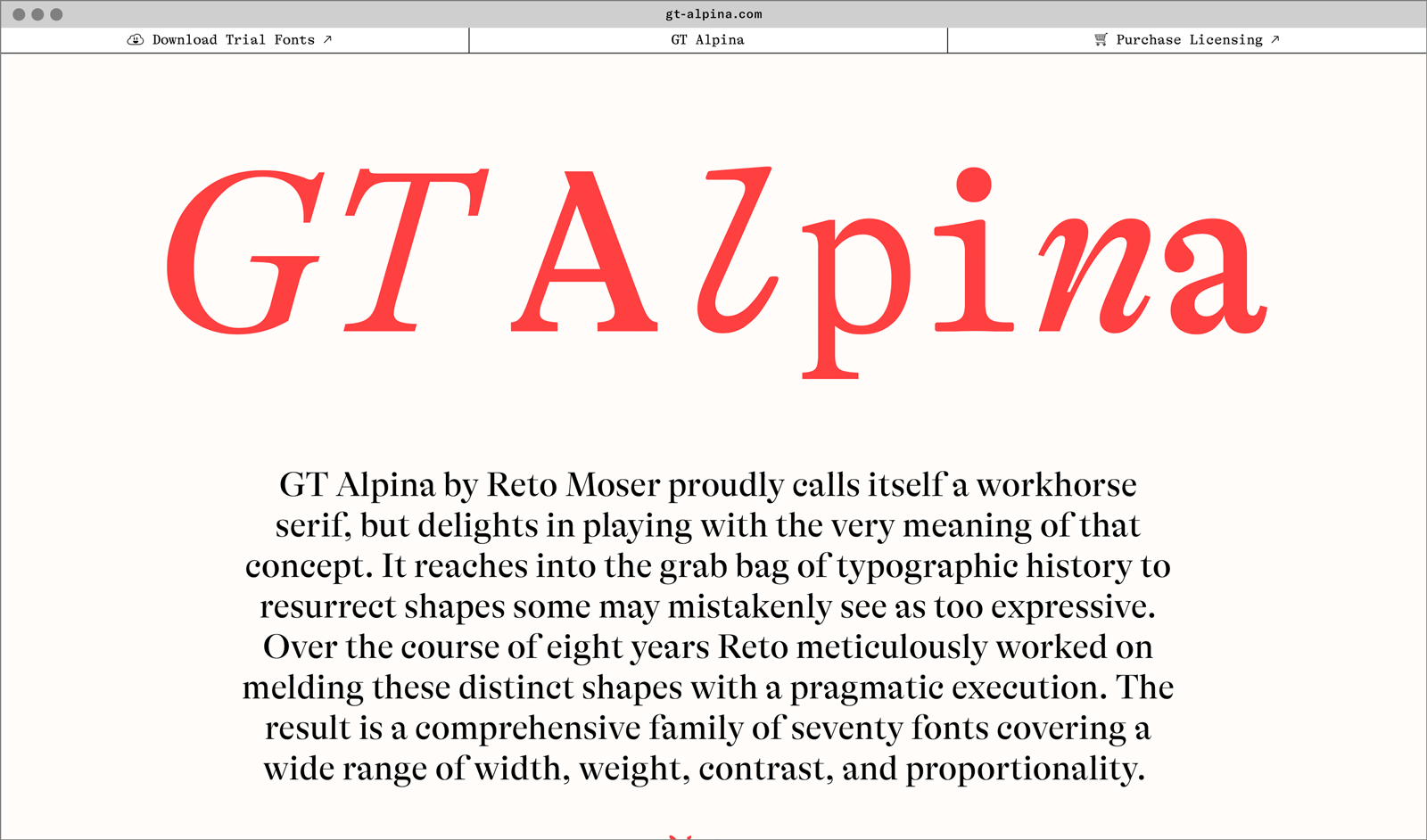
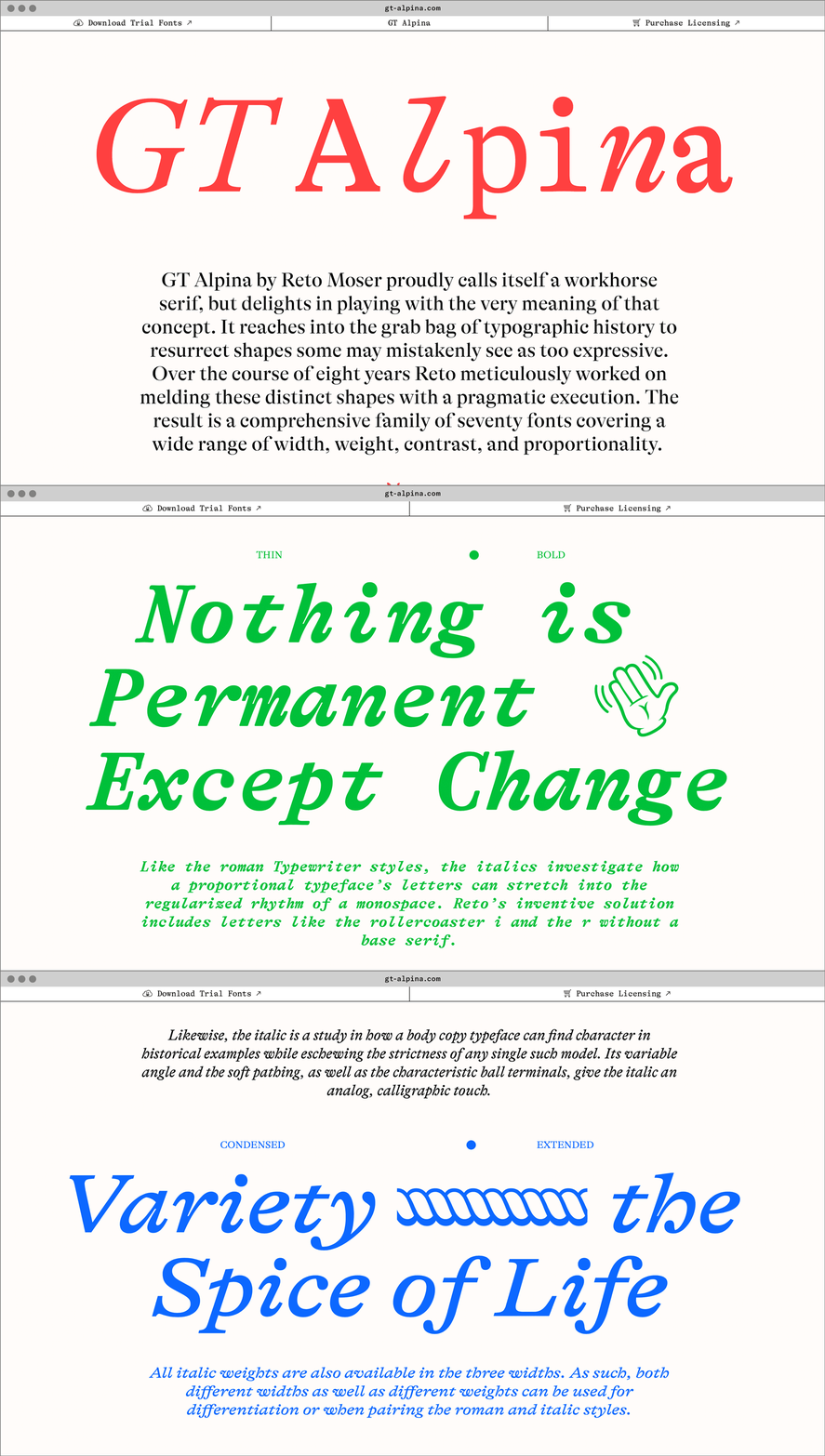
- Visit the GT Alpina minisite to discover more about the typeface family’s history and design concept.
GT Alpina in use


